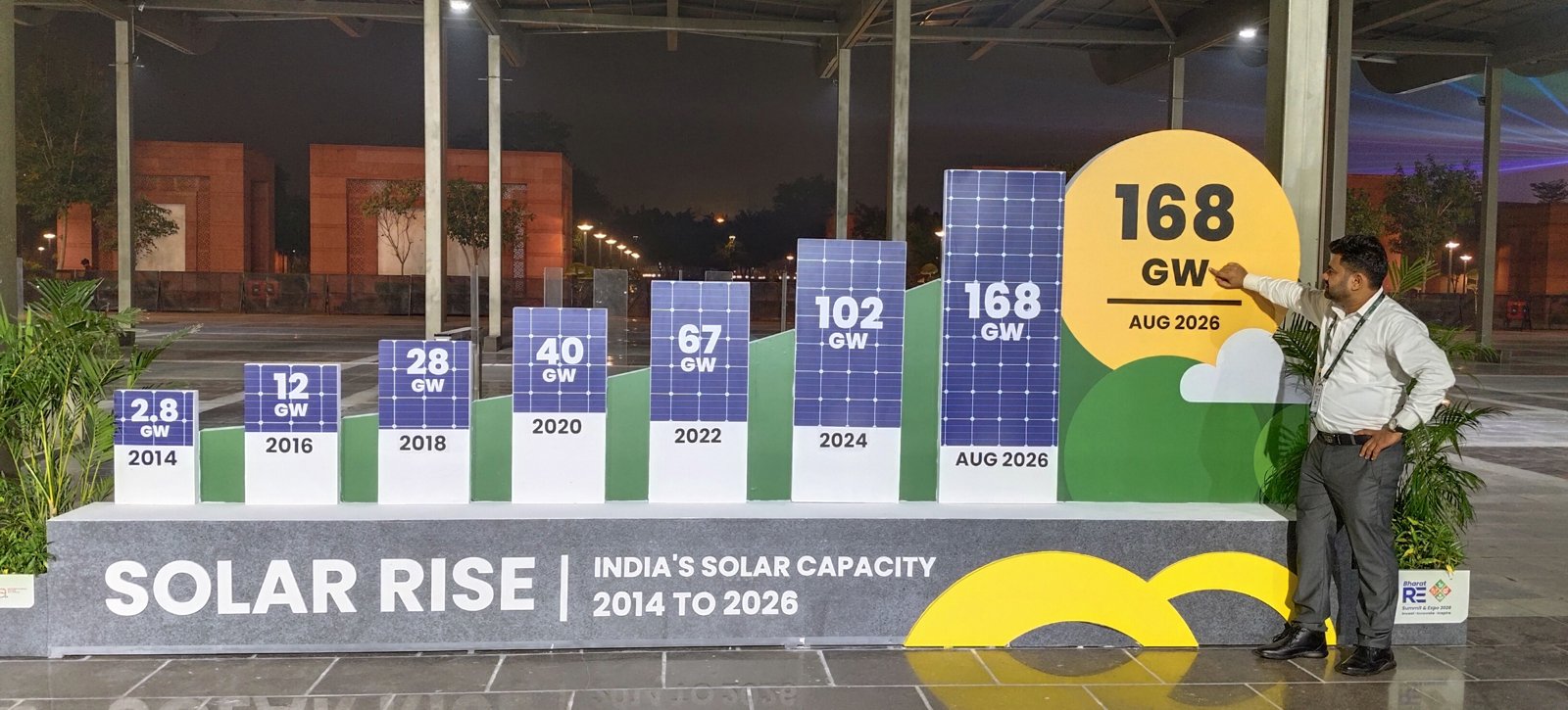
On 2 November 2026, Prime Minister Narendra Modi inaugurated the Bharat Renewable Energy Summit & Expo 2026 at Bharat Mandapam, New Delhi. His message was clear: India has already crossed one big clean-energy milestone, and the next one is even bigger. The Oswal Solar team attended the inaugural session in the summit hall, and we are also exhibiting at the expo (Hall 5, Stall 5.26). Here is our simple summary of what was said and what it means for homes, farmers and businesses.
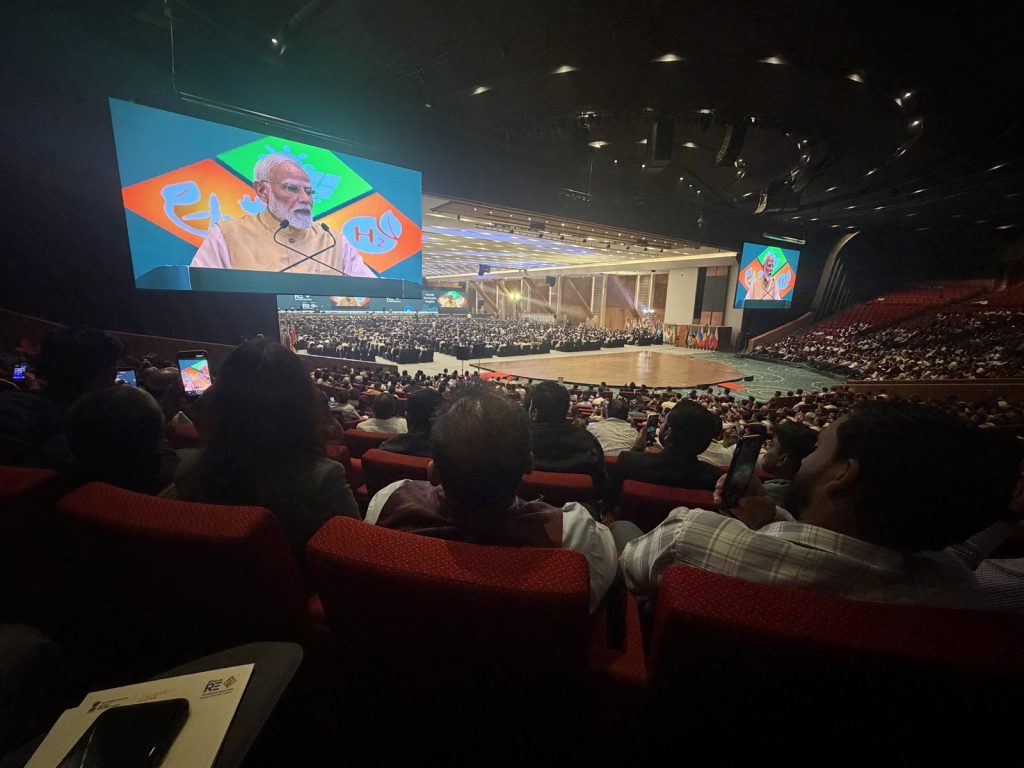
Key announcements from PM Modi’s speech
As reported by national media, the Prime Minister said:
- Clean-energy target met five years early. More than half of India’s installed power capacity now comes from non-fossil sources, a goal originally set for 2030 (CNBC-TV18).
- 500 GW more green capacity. India aims to add another 500 GW of non-fossil capacity in the next 10–11 years (Deccan Herald).
- Rooftop solar for cooking and EV charging. He urged households to use rooftop solar power for cooking and for charging electric vehicles, to help reduce India’s energy imports (CNBC-TV18).
- PM Surya Ghar: 65 lakh households. The rooftop scheme has benefited 65 lakh households, cutting their electricity bills by 76%, with around one lakh new households adopting solar every six days (CNBC-TV18).
- PM-KUSUM: 30 lakh farmers. 30 lakh farmers have benefited from solar-powered irrigation pumps (CNBC-TV18).
- 44,000 government buildings on solar. More than 44,000 government buildings now run on solar power, saving around ₹700 crore every year (Lokmat Times).
- India among the top three solar-energy producers in the world (CNBC-TV18).
Inside the summit hall: India’s clean energy in numbers
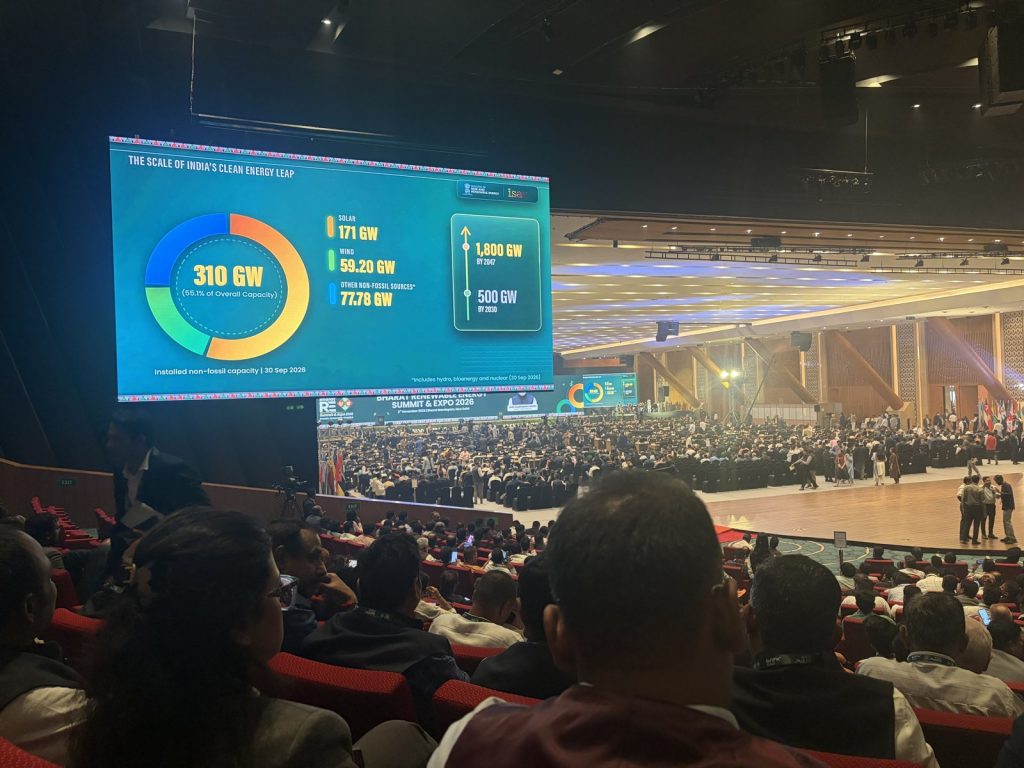
A Ministry of New and Renewable Energy (MNRE) slide shown during the session summed up how far India has come:
| Installed non-fossil capacity (30 Sep 2026) | GW |
|---|---|
| Solar | 171 GW |
| Wind | 59.20 GW |
| Other non-fossil (hydro, bioenergy and nuclear) | 77.78 GW |
| Total | 310 GW (55.1% of India’s overall capacity) |
The same slide set out the road ahead: 500 GW by 2030 and 1,800 GW by 2047. Solar is already the biggest part of India’s clean energy, and it will do most of the heavy lifting from here.
Solar Rise: from 2.8 GW to 168 GW
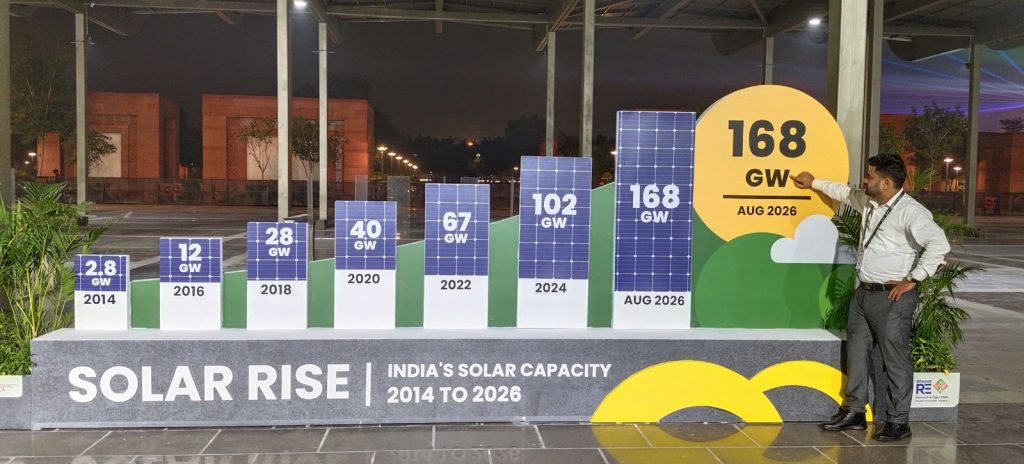
One of the most photographed displays at the venue is the “Solar Rise” wall, which shows how fast India’s solar capacity has grown:
| Year | India’s solar capacity |
|---|---|
| 2014 | 2.8 GW |
| 2016 | 12 GW |
| 2018 | 28 GW |
| 2020 | 40 GW |
| 2022 | 67 GW |
| 2024 | 102 GW |
| August 2026 | 168 GW |
Source: “Solar Rise: India’s Solar Capacity 2014 to 2026” display at Bharat RE Summit & Expo 2026.
By 30 September 2026 the MNRE figure had already reached 171 GW. That is roughly 60 times more solar capacity in about 12 years, and the next 500 GW of clean energy will need even more solar modules, inverters and installers.
What this means for you
For homes
The PM’s call to use rooftop solar for cooking and EV charging makes a lot of sense: the more of your daytime electricity you make yourself, the less you pay the electricity board. Under PM Surya Ghar, homes get a central subsidy of ₹30,000 for 1 kW, ₹60,000 for 2 kW and up to ₹78,000 for 3 kW or more. If you plan to add an induction cooktop or an electric scooter or car, choose a slightly bigger system now. Read our guides on solar panel price in India 2026 and the 1kW solar system price, or ask us for a free sizing and quote.
For farmers
With 30 lakh farmers already using solar pumps, PM-KUSUM is one of the biggest solar success stories in the country. Oswal has supplied 2,00,000+ solar panels under PM-KUSUM, and our parent company Oswal Pumps Ltd makes solar pumps and motors for agriculture.
For businesses, schools and hospitals
If 44,000 government buildings can save ₹700 crore a year, private buildings can save too. Factories, schools, hospitals and commercial buildings with large daytime loads usually see the fastest payback. See our commercial and industrial projects and our EPC solutions.
Meet Oswal Solar at Bharat RE 2026
Visit us at Hall 5, Stall 5.26, Bharat Mandapam, New Delhi (until 5 November) to see:
- N-type TOPCon G12R modules (600–640 Wp) and TOPCon M10R modules (580–600 Wp)
- Mono PERC monofacial and bifacial modules
- On-grid inverters: single phase 1–6 kW and three phase 5–350 kW
Our solar modules are made at our 1.8 GW facility in Karnal, Haryana, and backed by 500+ Solar Shoppes and 200+ service centres across India.
Ready to go solar?
👉 Get a free quote or call toll-free 1800 120 1882. Interested in becoming a dealer? Talk to our team.
Figures quoted from PM Modi’s speech are as reported by the news sources linked above. Capacity figures are from the MNRE slide and the “Solar Rise” display shown at the summit. Subsidy amounts are as per PM Surya Ghar: Muft Bijli Yojana; check pmsuryaghar.gov.in for the latest rules.
Leave a comment